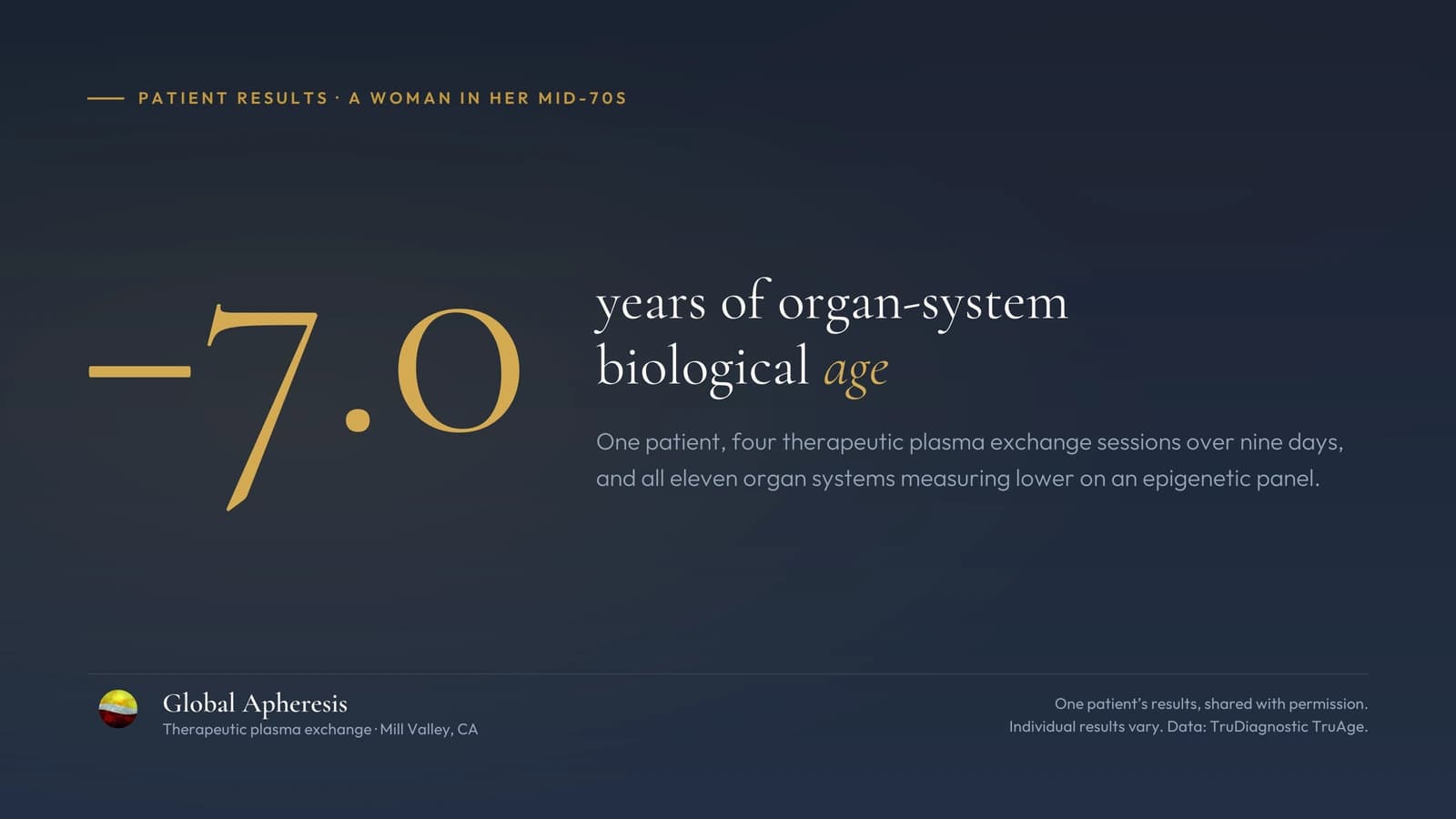
A woman in her mid-seventies came to us hoping to calm the inflammation behind a painful shoulder. She completed four therapeutic plasma exchange (TPE) sessions over nine days at our Mill Valley clinic, with albumin replacement and no IVIG. She took a TruDiagnostic TruAge epigenetic panel about a week before her first session and again about two weeks after her last.
In short: her SYMPHONY Age, which estimates the biological age of eleven organ systems from a single blood sample, fell from 70.5 to 63.5, a drop of 7.0 years. All eleven systems measured lower. Her pace-of-aging score held steady. This is one patient, measured over about a month, so it is a result to examine rather than proof of what TPE does for everyone.
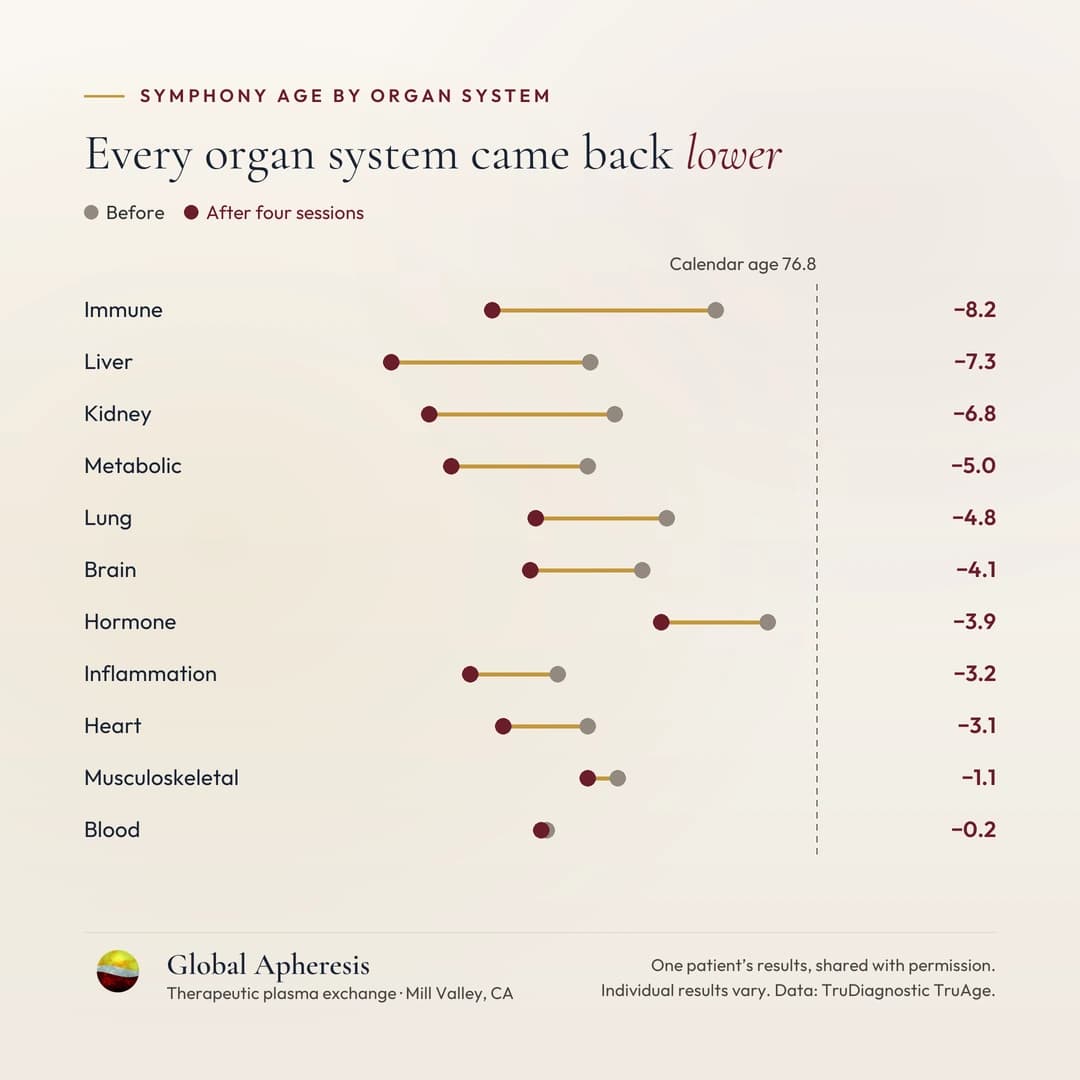
Every organ system measured lower
Her calendar age is 76.8. Every organ system started below that and moved lower still. The immune, liver and kidney estimates changed the most, while blood barely moved.
Other measures of biological age
The panel also reports several other clocks, computed from the same blood draw:
- OMICm Age: 59.5 → 57.6
- Telomere biological age: 59.2 → 55.7
- Estimated telomere length: 6.9 → 7.0
- DunedinPACE (pace of aging): 0.71 → 0.72
DunedinPACE asks a different question from the others. It estimates how fast aging is running now, not how much has accumulated, and it reflects months of biology rather than days. Hers was already well under 1.0, the line where the body ages one biological year per calendar year, and a change of 0.01 is flat. We didn’t expect four sessions to move it, and they didn’t.
That stillness is useful in its own way. If something about the procedure or the test were pushing every number down indiscriminately, the pace clock is where we would expect it to show.
The immune system moved furthest
Her immune system estimate fell 8.2 years, the largest change of the eleven. Her profile shifted toward more naive T cells, the “fresh” immune cells that respond to new threats, and a lower neutrophil fraction. With age, naive T cells usually decline and the neutrophil-to-lymphocyte ratio climbs. Hers moved the other way on both.
One caution in reading this: epigenetic age is measured on the white blood cells in the sample, so a change in which cells are present can move the estimate. A blood test can’t fully separate the two. Either way, the cell mix moved in the direction we would want.
In her words
“The shoulder is better. Pain is down to a 3 from a 9. Range of motion has increased.”
She didn’t come in for a number. She was sleeping better and still recovering when she wrote that.
What this does and doesn’t show
- One patient, about one month. Epigenetic clocks carry real test-to-test variability, and a single before-and-after on one person can’t separate a true change from it.
- Two weeks out is a close-in reading. It shows what changed, not what lasts.
- It is consistent with the trial data. Dr. Kiprov co-authored the randomized, placebo-controlled trial published in Aging Cell in 2025 that reported TPE lowering biological age on epigenetic clocks. We summarize it in How Therapeutic Plasma Exchange Reduces Biological Age.
What’s next
She plans to retest in a few months and again later in the year. We’ll update this page with those results, whichever way they go.
How therapeutic plasma exchange works
During therapeutic plasma exchange, plasma (the liquid part of the blood) is separated from the blood cells and replaced with an albumin solution. This removes circulating inflammatory proteins and other age-associated factors. Each session takes about two to three hours and is done at our Mill Valley clinic under physician supervision.
The panel she took is the same one we offer with a physician review of the results. If you want to know where your own numbers stand, see biological age testing.