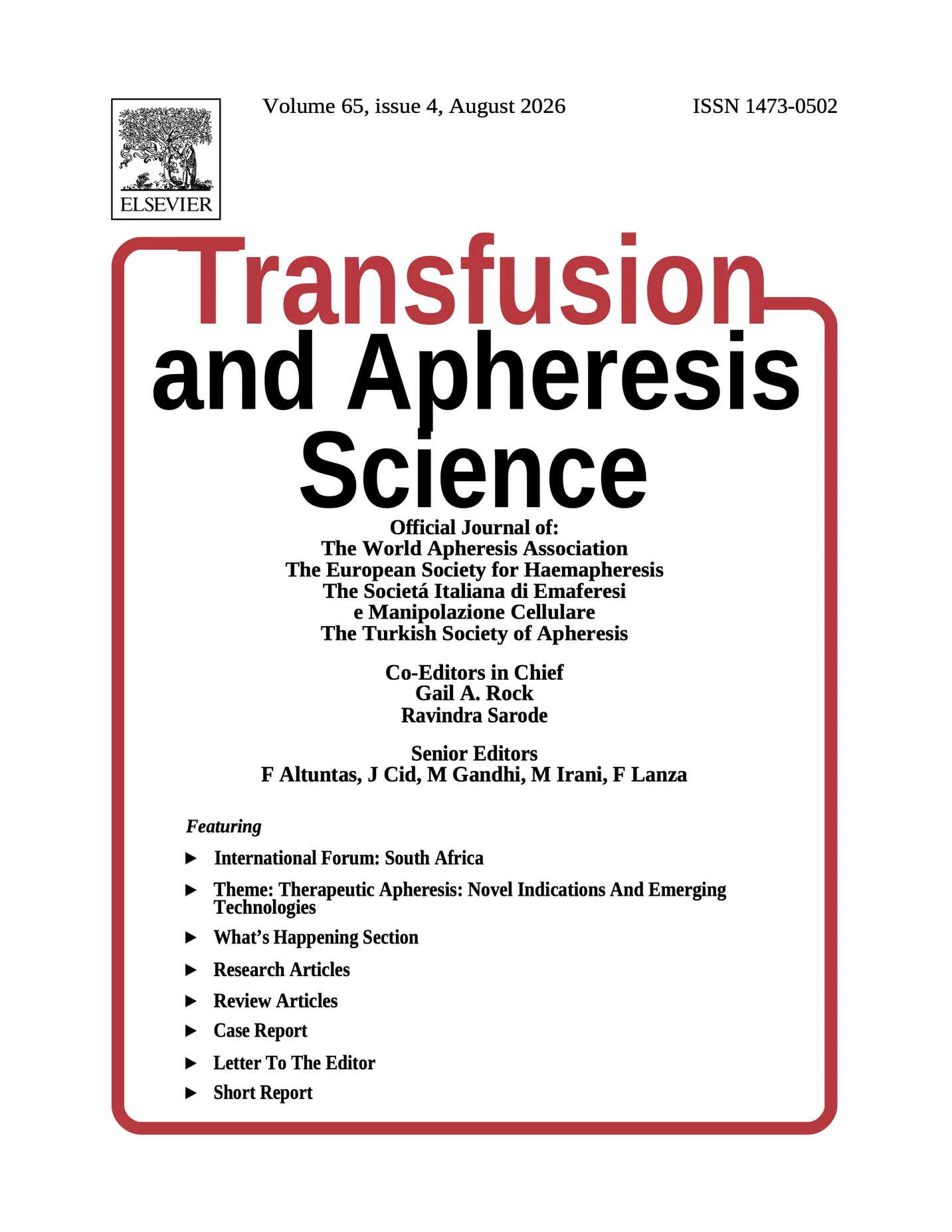
Cover of Transfusion and Apheresis Science, Volume 65, Issue 4, August 2026
Guest-Edited Theme Issue

Therapeutic Apheresis: Novel Indications & Emerging Technologies

Transfusion and Apheresis Science, Volume 65, Issue 4 — August 2026. The official journal of the World Apheresis Association, the European Society for Haemapheresis, the Societá Italiana di Emaferesi e Manipolazione Cellulare, and the Turkish Society of Apheresis.

Guest Editors

Dobri D. Kiprov, MD, HP · Allen P. Green, MD

Global Apheresis, Mill Valley, California

From the Editorial

Apheresis in Transition

Over the past decade, therapeutic apheresis has moved well beyond its established role in autoimmune, hematologic, and neurologic disease. Two forces are driving that expansion.

The first is the growing recognition that circulating mediators — autoantibodies, immune complexes, inflammatory cytokines, atherogenic lipoproteins, and protein-bound toxins — contribute to a widening range of conditions, which makes their removal a rational therapeutic strategy. The second is technological: a shift away from the wholesale removal of plasma and toward the selective extraction of specific pathogenic components.

Together, these developments mark a transition from apheresis as a rescue intervention toward what may be called precision apheresis. This theme issue brings together four contributions that map that transition across neurodegeneration, post-infectious immune dysregulation, cardiovascular and renal disease, and the technological frontier.

A recurring lesson runs through the work collected here: unselected populations are unlikely to benefit, and biomarker-guided patient selection is essential to define where apheresis has a role.

Adapted from Green AP, Kiprov DD. “Therapeutic apheresis in transition: New indications and the emergence of precision apheresis.” Transfus Apher Sci. 2026;65(4):104480.

In This Issue

Five Contributions

Abstracts are reproduced below. Every article links to its permanent DOI record; full texts are available from the guest editors on request.

01Editorial

Therapeutic apheresis in transition: New indications and the emergence of precision apheresis

Allen P. Green, Dobri D. Kiprov

Global Apheresis Inc., Mill Valley, CA

Why It Matters

This is the argument that organizes the rest of the issue: apheresis is moving from a procedure of last resort toward a targeted, repeatable therapy defined by what it removes.

Abstract

The guest editors’ introduction to the theme issue. Two forces are expanding therapeutic apheresis beyond its established role in autoimmune, hematologic, and neurologic disease: the growing recognition that circulating mediators — autoantibodies, immune complexes, inflammatory cytokines, atherogenic lipoproteins, and protein-bound toxins — contribute to a widening range of conditions, and a technological shift away from the wholesale removal of plasma toward the selective extraction of specific pathogenic components. Together these mark a transition from apheresis as a rescue intervention toward what may be called precision apheresis.

02Review

Therapeutic plasma exchange in Alzheimer’s disease: From clinical trial to real-world evidence

Bhupendra O. Khatri

Center for Neurological Disorders, Milwaukee, WI

Why It Matters

AMBAR remains the only randomized controlled trial of plasma exchange in Alzheimer’s disease. Khatri sets it alongside the outpatient experience that has accumulated since, and argues that a broadly acting therapy may complement rather than compete with anti-amyloid antibodies.

Abstract

This article examines the expanding role of therapeutic plasma exchange (TPE) in Alzheimer’s disease (AD), alongside recent developments in diagnostic approaches, disease mechanisms, and emerging disease-modifying treatments. Although AD has historically been considered a disorder defined by amyloid and tau pathology, contemporary models increasingly emphasize a multifactorial systems-biology framework that includes immune dysregulation, oxidative stress, vascular injury, impaired protein clearance, and synaptic dysfunction. Within this evolving model, TPE has emerged as a biologically rational, broadly acting therapeutic strategy that contrasts mechanistically with selective anti-amyloid monoclonal antibodies. The article reviews the AMBAR trial and the pilot work that supported it, real-world cohort evidence, the author’s clinical experience, and the evolution of TPE from acute hospital-based therapy to chronic outpatient disease management.

03Review — Open Access

Therapeutic plasma exchange and immunomodulatory strategies in post-infectious syndromes: A review of immune dysregulation in PTLDS, long COVID, ME/CFS, and PANS/PANDAS

Gary Kaplan

Kaplan Center for Integrative Medicine · Georgetown University School of Medicine

Why It Matters

The central lesson is patient selection. Two negative trials in unselected populations sit alongside observational benefit in patients with demonstrable autoantibody burden — evidence that immunologic testing should precede immune-directed treatment.

Abstract

Post-infectious syndromes including post-treatment Lyme disease syndrome (PTLDS), long COVID, myalgic encephalomyelitis/chronic fatigue syndrome (ME/CFS), and PANS/PANDAS share overlapping clinical phenotypes characterized by fatigue, cognitive dysfunction, sleep disturbance, and neuropsychiatric symptoms. This narrative review synthesizes the literature describing immune abnormalities across these syndromes and evaluates the rationale for immunomodulatory therapies, including IVIG, rituximab, and therapeutic plasma exchange. Notably, the phase III RituxME trial in ME/CFS and a phase II trial of TPE in post-COVID condition both failed to demonstrate efficacy in unselected populations, reinforcing the importance of biomarker-guided patient stratification.

04Review

Lipoprotein apheresis: From familial hypercholesterolemia and elevated lipoprotein(a) to emerging roles in peripheral arterial and renal disease

Menatalla Nadim, Yamac Akgun

Department of Pathology and Laboratory Medicine, University of Miami Miller School of Medicine

Why It Matters

Lipoprotein apheresis is the one apheresis modality with decades of registry outcome data. The review maps honestly where it still matters as a new generation of Lp(a)-lowering drugs arrives.

Abstract

Lipoprotein apheresis (LA) achieves acute reductions of 60–80% in LDL cholesterol and lipoprotein(a) through extracorporeal removal of apolipoprotein B-containing particles, and remains the cornerstone of treatment for homozygous familial hypercholesterolemia and severe heterozygous FH refractory to pharmacotherapy. Registry data, including more than 11 years of follow-up from the German Lipoprotein Apheresis Registry, document consistent reductions in major adverse cardiovascular events across all principal indications, though randomized controlled trial evidence is absent. The review examines integration with PCSK9 inhibitors, inclisiran, and emerging RNA-based Lp(a)-lowering agents, and evaluates evidence in peripheral arterial disease and steroid-resistant focal segmental glomerulosclerosis.

Transfus Apher Sci. 2026;65(4):104483. doi:10.1016/j.transci.2026.104483

Related at Global Apheresis:Lipid Apheresis
05Review

Technological advances in selective plasma adsorption: The MTx.100 column and the emergence of subtractive precision medicine

Dobri D. Kiprov, Allen P. Green, Prithvi Boyinapalli

Global Apheresis Inc., Mill Valley, CA · Marker Therapeutics AG, Zug · Clarify Clinics, London

Why It Matters

Where plasma exchange removes the whole plasma compartment, selective adsorption removes a defined cargo and gives the patient their own plasma back. A pilot trial in Alzheimer’s disease is underway.

Abstract

Therapeutic plasma exchange is well established but intrinsically non-selective: protective immunoglobulins, coagulation factors, and albumin are depleted alongside pathogenic substances, and reliance on donor-derived replacement fluid carries logistical and immunological costs. The MTx.100 column is a selective plasma adsorption device that targets pro-inflammatory cytokines, protein-bound metabolic waste, hydrophobic environmental contaminants, and microparticulates while preserving immunoglobulins, coagulation factors, and electrolytes — the patient’s own plasma is treated and returned, eliminating replacement-fluid dependency. Clinical experience encompasses approximately 1,000 procedures globally, including a prospective multicenter trial in 107 critically ill COVID-19 patients and 114 elective outpatient procedures in which third-party laboratory analyses confirmed measurable reduction of PFAS, microplastics, and persistent organic pollutants.

Available on Request

Request the Full Texts

Four of the five articles are published under standard Elsevier copyright, so the final versions cannot be posted publicly. As guest editors, we are able to share individual copies directly with colleagues, referring physicians, researchers, and patients who ask. Dr. Kaplan’s review is open access and can be read in full at the link above.

How to Request

Send us a message through the contact form and mention “TAS theme issue” along with which article or articles you would like. Please include your name and institution or practice so we can address the reply. We respond within one business day.

Prefer the phone? Call (415) 928-1352, or write to info@globalapheresis.com.

Looking for more of our published work? Browse selected peer-reviewed publications →