If you’ve scheduled your first therapeutic plasma exchange, you probably have questions. That’s normal. Most patients arrive with some mix of curiosity and nervousness, and nearly all of them leave wondering what they were worried about.
Therapeutic plasma exchange can and should be an easy, even relaxing process. Here’s exactly what to expect, from the days before your appointment through the moment you walk out.
Before Your Appointment
Preparation starts a few days beforehand, and it’s straightforward.
Hydrate well. Aim for about three liters of water per day for several days leading up to your procedure. Good hydration makes your veins easier to access and helps your body respond well to the exchange. Avoid dehydrating activities like very strenuous exercise or sauna the night before.
Rest the night before. A good night’s sleep sets the stage for a smooth procedure. Avoid alcohol the evening before your appointment.
Eat a full meal. You can and should eat normally before your session. A solid meal beforehand helps prevent nausea and fatigue during the procedure. This is not a fasting procedure.
Medications. If you take blood pressure medications in the morning, it is often recommended to hold them until after the procedure. Most other medications can be taken as normal, but your physician will review your full medication list with you before your first session.
Clothing. Wear something comfortable with easy access to the veins at your inner elbows. Loose sleeves or a short-sleeved shirt works well. You’ll be seated or reclined for about two hours, so comfort matters.
Arriving at the Clinic
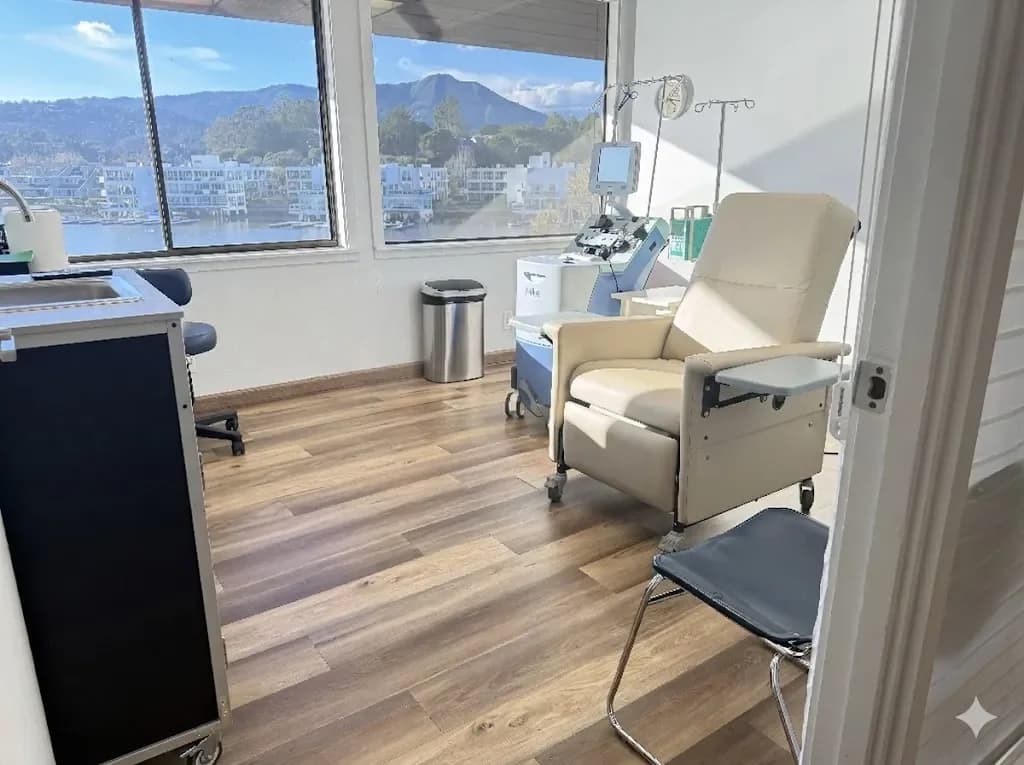
Our Mill Valley clinic sits at 655 Redwood Highway with views of the bay and Mt. Tamalpais. The treatment room is peaceful and private.
When you arrive, you’ll have your choice of a bed or a reclining chair. Take whichever feels more comfortable. Many patients prefer the recliner.
The Procedure
IV access. A nurse will place an IV line in each arm. Our nursing team is highly experienced in apheresis procedures and uses lidocaine to numb the insertion sites. Most patients tell us the IVs are much less painful than they expected. Once both lines are in place, they’re connected to the apheresis machine and the procedure begins.
What happens during the exchange. The process itself is painless. A relatively small volume of blood, between 160 and 250 mL depending on the machine, is outside your body at any given time. It is continuously processed: the machine separates your plasma from your blood cells, removes the old plasma, and returns your cells along with fresh albumin solution. This cycle runs continuously for approximately two hours.
What you can do. One arm is typically free to move as you wish, while the other should remain relatively straight to avoid shifting the needle. Patients read, work on laptops, watch something on their phone, or simply close their eyes and rest. Some people nap through the entire session.
Your care team. A nurse will remain with you for the entire procedure and will check your vital signs at roughly 20-minute intervals. Your physician will also stop in periodically to see how things are going and answer any questions.
After the Procedure
When the exchange is complete, your nurse will disconnect the lines and place a bandage on each arm. Leave the bandages on for several hours.
Beyond that, there are no restrictions. You can drive, travel, eat, and go about your day as normal.
How you’ll feel. Most patients feel exactly the same as when they started the day. A small percentage feel a little tired, as if they’d like a short nap, but not so tired that it interferes with their plans. And some patients notice an immediate boost in energy and vitality. Everyone responds a bit differently, but the vast majority describe the experience as unremarkable in the best possible way.
What About the Second Session?
Subsequent sessions follow the same process. The only thing that changes is you. Most patients find the second and third sessions even more comfortable once the novelty and first-time anxiety have worn off. By the time you’re a few sessions in, it feels routine.
Frequently Asked Questions
Does it hurt?
The IV insertion involves a brief pinch, minimized by lidocaine. The exchange itself is completely painless. Most patients are surprised by how little they feel.
How long does it take?
The procedure itself takes approximately two hours. Plan for about three hours total to allow time for setup and wrap-up.
Can I drive myself?
Yes. There are no restrictions on driving or travel after the procedure.
How many sessions will I need?
This varies by condition and treatment goals. A typical protocol involves four to six sessions, but your physician will design a plan specific to your situation during your discovery call.
Will I need someone to come with me?
It’s not required. Most patients come alone and drive themselves home. If it would ease your nerves to bring someone for your first visit, they’re welcome to sit with you.
Therapeutic plasma exchange is one of those procedures that sounds more intimidating than it actually is. The most common thing we hear from patients after their first session is some version of “that’s it?” If you’re considering TPE and want to learn more about whether it’s right for you, we’re happy to talk it through.
Allen P. Green, M.D., is Board-Certified in Clinical Pathology and serves as Associate Medical Director at Global Apheresis in Mill Valley, California. He writes on plasma exchange, environmental medicine, and longevity research at allenpgreenmd.com.