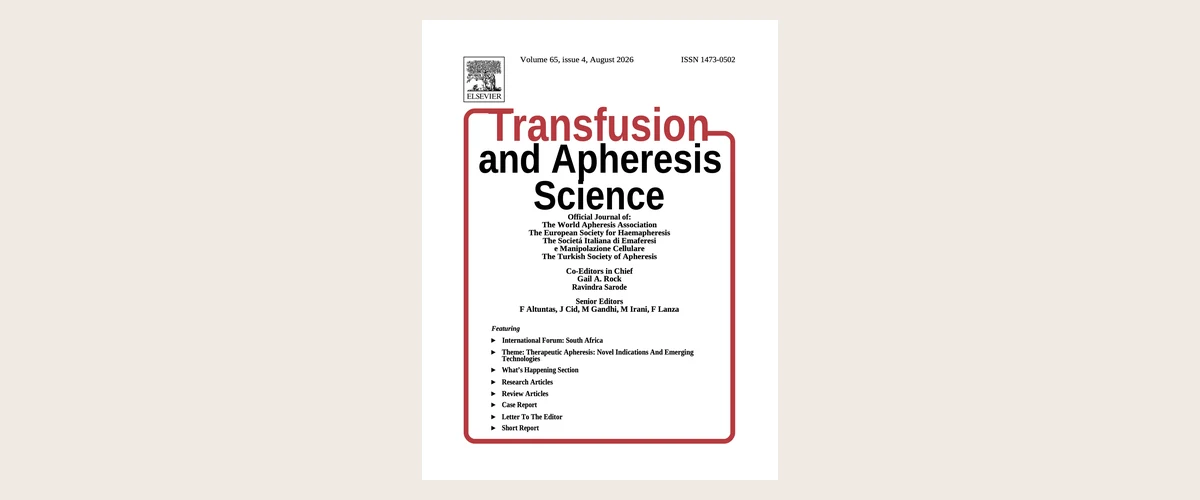
Dr. Dobri Kiprov and I were invited to guest-edit a theme issue of Transfusion and Apheresis Science — the official journal of the World Apheresis Association, the European Society for Haemapheresis, the Societá Italiana di Emaferesi e Manipolazione Cellulare, and the Turkish Society of Apheresis. It was published in August 2026 as Volume 65, Issue 4, under the theme Therapeutic Apheresis: Novel Indications and Emerging Technologies.
Guest-editing is different from writing a paper. You are not making one argument; you are deciding which arguments belong in the same room. What follows is why we chose the four we did.
The thesis: from rescue to precision
For most of its history, therapeutic apheresis has been a rescue intervention — something you reach for when a patient is in crisis and conventional therapy has failed. That framing is now too narrow, and two separate forces are pushing against it.
The first is biological. We increasingly recognize that circulating mediators — autoantibodies, immune complexes, inflammatory cytokines, atherogenic lipoproteins, protein-bound toxins — contribute to a widening range of conditions. If a soluble factor in the blood is driving disease, removing it is a rational therapeutic strategy rather than a desperate one.
The second is technological. The field is shifting away from removing plasma wholesale and toward extracting specific pathogenic components while leaving the rest of the plasma intact.
Put those together and you get something that deserves its own name. In our editorial we called it precision apheresis: a therapy defined not by the volume it removes, but by what it removes.
The four articles
Alzheimer’s disease. Dr. Bhupendra Khatri traces plasma exchange in Alzheimer’s from the AMBAR trial — still the only randomized controlled trial in this indication — through the real-world outpatient experience that has accumulated since. His framing is one I find persuasive: a broadly acting intervention like TPE may complement selective anti-amyloid antibodies rather than compete with them, because contemporary models of Alzheimer’s include immune dysregulation, oxidative stress, vascular injury, and impaired protein clearance, not amyloid alone.
Post-infectious syndromes. Dr. Gary Kaplan reviews immune dysregulation across post-treatment Lyme disease syndrome, long COVID, ME/CFS, and PANS/PANDAS. This is the article I would most want a skeptical colleague to read, because it does not oversell. The phase III RituxME trial in ME/CFS and a phase II trial of TPE in post-COVID condition both failed in unselected populations. Kaplan’s conclusion is not that immune-directed therapy doesn’t work — it’s that giving it to everyone with fatigue guarantees it will look like it doesn’t. Patients with a demonstrable autoantibody burden are a different population from patients without one. Test first.
Lipoprotein apheresis. Nadim and Akgun cover the one apheresis modality with decades of registry outcome data behind it, including more than eleven years of follow-up from the German Lipoprotein Apheresis Registry. They are candid that randomized controlled trial evidence is absent, and equally candid that PCSK9 inhibitors and the coming generation of RNA-based Lp(a)-lowering drugs will keep shrinking its LDL-centric use. What survives, in their reading, is a narrower but real role in Lp(a)-driven disease and in selected vascular and renal phenotypes.
Selective adsorption. Dr. Kiprov, Prithvi Boyinapalli, and I describe the MTx.100 column, which uses hydrophobic-affinity adsorption to target inflammatory cytokines, protein-bound metabolic waste, hydrophobic environmental contaminants, and microparticulates — while preserving immunoglobulins, coagulation factors, and electrolytes. Because the patient’s own plasma is treated and returned, there is no donor-derived replacement fluid at all. Roughly 1,000 procedures have been performed globally to date, and a pilot trial in Alzheimer’s disease is underway.
The lesson that runs through all four
Reading these papers side by side, one theme kept surfacing that none of the authors had coordinated on: unselected populations are unlikely to benefit.
It appears in Kaplan’s two negative trials. It appears in Nadim and Akgun’s insistence that lipoprotein apheresis earns its place in specific phenotypes rather than broadly. It is implicit in Khatri’s account of who did well in AMBAR.
This matters for how you should read any enthusiastic claim about apheresis, including claims made by people who perform it. The honest question is never “does plasma exchange work?” It is “does it work for this patient, and what measurement tells us so?” A field that answers the first question loudly and the second one vaguely is not yet a mature one. Biomarker-guided patient selection is what moves apheresis from promising to precise.
Reading the issue
All five articles are available to download from our theme issue page, alongside the abstracts and a permanent DOI link for each one. Dr. Kaplan’s review is open access and can also be read at no cost through the publisher.
If you have questions about any of the work — or about whether apheresis has a role in a particular case — get in touch.
Allen P. Green, M.D., is Board-Certified in Clinical Pathology and serves as Associate Medical Director at Global Apheresis in Mill Valley, California. He writes on plasma exchange, environmental medicine, and longevity research at allenpgreenmd.com.
To discuss whether therapeutic plasma exchange is appropriate for your situation, schedule a complimentary Discovery Call. Most consultations are conducted via telehealth.
References
Green AP, Kiprov DD. Therapeutic apheresis in transition: New indications and the emergence of precision apheresis. Transfus Apher Sci. 2026;65(4):104480.
Khatri BO. Therapeutic plasma exchange in Alzheimer’s disease: From clinical trial to real-world evidence. Transfus Apher Sci. 2026;65(4):104481.
Kaplan G. Therapeutic plasma exchange and immunomodulatory strategies in post-infectious syndromes: A review of immune dysregulation in PTLDS, long COVID, ME/CFS, and PANS/PANDAS. Transfus Apher Sci. 2026;65(4):104482.
Nadim M, Akgun Y. Lipoprotein apheresis: From familial hypercholesterolemia and elevated lipoprotein(a) to emerging roles in peripheral arterial and renal disease. Transfus Apher Sci. 2026;65(4):104483.
Kiprov DD, Green AP, Boyinapalli P. Technological advances in selective plasma adsorption: The MTx.100 column and the emergence of subtractive precision medicine. Transfus Apher Sci. 2026;65(4):104484.
Boada M, López OL, Olazarán J, et al. A randomized, controlled clinical trial of plasma exchange with albumin replacement for Alzheimer’s disease: Primary results of the AMBAR study. Alzheimer’s & Dementia. 2020;16(10):1412–1425.