On September 9, Giorgos Mazonakis, one of Greece’s best-loved singers, died at 54 after going into cardiac arrest during a plasmapheresis session at a private practice in Athens. He grew up in a poor Athens neighborhood, became a national star, and was known for his charity work. Thousands of people came to his funeral. Our thoughts are with his family, his friends, and everyone who loved his music.
His death has set off a wide conversation among physicians, people interested in longevity medicine, and the public. Much of it has been about whether plasma exchange itself is dangerous. Therapeutic plasma exchange (TPE) is what we do every day, so we want to give a plain account of what is known, what isn’t, and what the evidence says about the risks.
What we know so far, and what we don’t
The investigation is still underway, and the autopsy results have not been released. Nobody outside the investigation knows exactly what happened, and I won’t pretend to. Here is what Greek officials and news outlets have reported so far.
The setting
- The practice wasn’t authorized for the procedure under Greek law. According to Greece’s Health Minister, the office was licensed only as an internal medicine practice, and plasmapheresis was outside what that license allowed.
- The equipment may not have been standard TPE. Several Greek outlets report that the device was an INUSpheresis system. INUSpheresis is a proprietary form of double filtration plasmapheresis. It runs the patient’s plasma through filters and returns it to the body. Standard TPE instead removes the plasma and replaces it with albumin. We explain the differences in detail in INUSpheresis vs. TPE. If these reports are accurate, the treatment he received was not the albumin-based plasma exchange studied in most of the research below and used throughout the United States, including at our clinic.
The timeline, as reported
- He arrived around 1:55 p.m., and the machine’s log shows it started at 2:14 p.m.
- The machine reportedly logged a clotting alert about ten minutes in, yet it kept running until about 2:57 p.m., roughly 42 minutes in total.
- Investigators say a photo taken at 2:45 p.m., while the machine was still running, shows him unconscious.
- Emergency services weren’t called until 4:21 p.m., 84 minutes after the machine stopped. Paramedics reportedly found that the practice’s defibrillator was not working.
- He was pronounced dead at a hospital at 5:40 p.m.
The accused
The two physicians, a married couple, have been arrested and deny responsibility. Police say digital evidence contradicts parts of their account.
These are allegations, not findings, and the accused are entitled to due process.
Was he already unwell?
This question has received less attention than it deserves.
The treating physician’s account:
- He had contacted her the day before with health concerns.
- He mentioned a strange cough, agitation, and difficulty standing for long.
- He was taking a diuretic for fluid retention.
- At his visits on both days, he was having difficulty speaking clearly.
- His vital signs were normal at first. Then, while a second IV line was being placed, his blood pressure and oxygen levels suddenly dropped and his heart stopped.
Accounts from others at the practice: staff described him on arrival as “somewhat disoriented” and “a little lost,” with a large bandage on his forehead.
The family’s account: their lawyer says he had no health problems and no known heart condition.
These accounts conflict, and the physician’s version is also contradicted by the machine log, which shows the treatment ran for more than 40 minutes. It is possible that a cardiac event had begun before, or regardless of, the treatment itself. The autopsy should help answer that.
Here is the point that doesn’t depend on the answer. If a patient arrives for an elective wellness procedure with trouble speaking, confusion, a new cough, fluid retention, or difficulty standing, a trained team does not proceed. Those are warning signs that call for urgent medical evaluation, not a treatment session. Deciding not to treat on a given day is one of the most important safety decisions in apheresis.
Two possible explanations, and why both point to the same lesson
When someone dies during TPE, there are really only two broad explanations.
Either something went seriously wrong with how the procedure was done. Examples include the wrong replacement fluid, skipped safety labs, unsuitable equipment, ignored alarms, or a patient who should never have been treated that day.
Or it was a tragic coincidence. A heart attack or arrhythmia can happen anywhere: at a desk, on a treadmill, or in a treatment chair. If he was already having a cardiac problem when he arrived, the treatment may have had little to do with it.
Even in the second case, the setting shapes the outcome. A properly staffed apheresis unit would likely have postponed treatment for a patient with those symptoms. If a cardiac event happens anyway, the team catches it within seconds. They stop the procedure, start resuscitation with working equipment, and call emergency services right away. What separates a survivable event from a fatal one is often the few minutes after it starts. Based on what has been reported, those minutes, and many more, were lost.
What the evidence says about TPE safety
Two points matter when you read the safety literature on TPE.
First, most of the data come from very sick patients. For decades, TPE has been used mainly in hospitals for conditions such as TTP, Guillain-Barré syndrome, myasthenic crisis, kidney failure caused by vasculitis, and liver failure. Some of these patients are in intensive care. When one of them has a cardiac arrest or dies, the illness that put them in the hospital is often the cause, not the exchange. A complication that happens during a procedure is not necessarily caused by it, and good studies make that distinction.
Second, the replacement fluid changes the risk. Hospital TPE often uses donor plasma (fresh frozen plasma), which is required for conditions like TTP. Donor plasma carries the risks of any transfusion, including allergic reactions, anaphylaxis, and lung injury. Longevity and wellness protocols use albumin, a purified protein solution with a very different risk profile. Studies that combine the two fluids overstate the risk for albumin-based exchange.
With that in mind, here is what the data show.
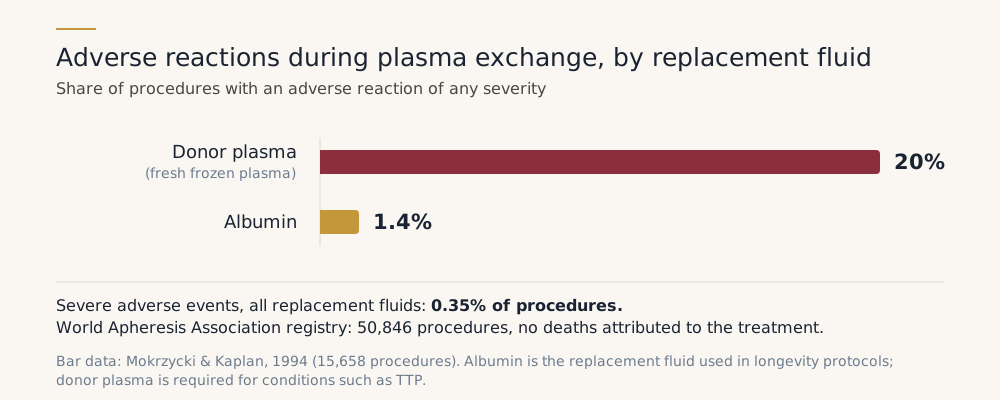
Deaths caused by the procedure itself are exceedingly rare. The World Apheresis Association (WAA) registry covered 50,846 procedures in 7,142 patients, and the authors reported that no deaths were attributed to the apheresis treatment. Older reviews give an often-quoted figure of about 0.05% (8 deaths in 15,658 procedures; Mokrzycki & Kaplan, 1994). That figure counts deaths that occurred in treated patients, drawn largely from the earlier, hospital-based era of the procedure, and it includes both plasma and albumin exchanges. It is not a measure of how often TPE kills a healthy person.
Serious complications are uncommon, and they cluster in sicker patients. In the WAA registry, 5.8% of procedures had an adverse event of any kind, most of them mild or moderate (tingling from citrate, lightheadedness, nausea). Only 0.35% had a severe adverse event. The severe-event rate varied with the underlying disease: it was highest in kidney patients (1.0%) and rheumatology patients (0.6%), and lowest in endocrine patients and transplant rejection cases (0.2% each). The authors link part of that variation to the disease itself and to medications such as ACE inhibitors and diuretics. Severe arrhythmia occurred in about 2 per 10,000 procedures, and asystole in about 0.2 per 10,000.
Albumin avoids most allergic risk. In the Mokrzycki and Kaplan review, adverse reactions occurred in 1.4% of albumin exchanges and 20% of fresh frozen plasma exchanges. In the WAA registry, hives were about 19 times more likely with plasma than with albumin, and anaphylaxis of any cause occurred in about 0.2 per 10,000 procedures. Albumin has its own weak point: low blood pressure was the leading severe event when albumin alone was used. This is predictable and manageable with proper fluid balance and monitoring. Rhythm problems occurred at similar, very low rates with either fluid.
The best data for our population come from AMBAR. In this randomized controlled trial, people with Alzheimer’s disease (average age 69) received plasma exchange with albumin replacement, with no donor plasma involved. Across 4,709 procedures, including sham procedures, at least one adverse event occurred in 16.9% of full-volume exchanges and 12.5% of low-volume exchanges. These events were minor and manageable. The most common were problems at the catheter or needle site, such as redness (about 3 to 4% of procedures); dizziness, tingling, or feeling faint (about 3%); and low blood pressure (about 3 to 4%). Catheter-related problems were more frequent when a central line was used than with arm veins. The investigators concluded that the exchanges were as safe and feasible in this older population as in other uses of plasma exchange. These patients were older than the typical longevity patient, and many had other medical conditions. We cover the trial in more depth in The AMBAR Trial: What It Means for Alzheimer’s Patients and Families.
Filtration methods such as INUSpheresis. Double filtration plasmapheresis (DFPP), the broader category INUSpheresis belongs to, has been used for decades, particularly in Japan and elsewhere in Asia. It is used for kidney transplant preparation, some neurological and autoimmune conditions, and lipid disorders. Published experience suggests it is generally safe in trained hands. Its main risks are low blood pressure and, because the filters also remove large clotting proteins such as fibrinogen, bleeding if clotting levels fall too low. No donor products are used, so transfusion-type allergic reactions are not a major concern.
Data on INUSpheresis itself are much more limited. The published work consists mainly of small observational studies from Europe. One example is a 2023 study of 27 people with Long COVID, which did not report detailed safety results. There are no large registries or randomized trials comparable to those for TPE, so its specific safety profile is not well established. None of this means the device caused Mr. Mazonakis’s death. It means the large body of safety evidence behind albumin-based TPE may not apply to the treatment he received.
In short, when TPE uses albumin and is performed correctly in people who are not acutely ill, serious complications are measured in fractions of a percent. Deaths caused by the procedure itself are exceedingly rare.
Why “safe” doesn’t mean “simple”
This safety record has an unintended consequence. Because TPE is so safe in expert hands, some clinics assume anyone can do it. They buy a machine, have a sales representative train the staff, and add “plasma exchange” to the menu.
That is a mistake. TPE is safe because trained people handle the risks as they arise:
- Citrate, the anticoagulant used during the procedure, lowers blood calcium. Too little calcium can affect heart rhythm, so it has to be anticipated and replaced.
- Fluid shifts can drop blood pressure quickly, especially in people who are dehydrated, on certain blood pressure medications, or who have heart disease.
- Machine alarms, including clotting, pressure, and air alarms, mean something. Each one requires a specific response. The machine should never be left running while the problem is sorted out.
- Screening before treatment is essential: recent labs, a review of heart history and medications, and a judgment about whether this patient should be treated today.
- Emergency readiness means staff certified in resuscitation, emergency medications and equipment in the room, and a clear plan for calling emergency services right away.
None of this is hard for a team that does TPE every day. All of it is dangerous for a team that doesn’t.
How Global Apheresis approaches this
In the United States, therapeutic apheresis falls under transfusion medicine, which is part of the training of clinical pathologists and transfusion medicine specialists. Global Apheresis is physician-led, and our physicians are trained in that specialty, the one that oversees apheresis in hospitals. Our nurses are apheresis-trained and perform plasma exchange as their core work, not as an add-on to other duties.
That means every patient receives:
- Screening labs and a medical review before the first session, and before later sessions as needed
- Albumin as the replacement fluid, with calcium management throughout
- Continuous monitoring of blood pressure, heart rate, and oxygen levels
- An apheresis-trained nurse at the bedside for the entire procedure, with physician oversight
- Written emergency protocols and staff trained in advanced life support
If you want to see what that looks like from the patient’s side, we walk through it step by step in What to Expect During Your First TPE Session.
Questions to ask any clinic offering plasma exchange
Whether you choose us or someone else, please ask:
- Who is the supervising physician, and what is their training in apheresis or transfusion medicine?
- Who will be at my bedside, and how many TPE procedures have they performed?
- What replacement fluid do you use? For wellness and longevity protocols, the answer should generally be albumin.
- What labs and medical history do you review before treatment? Will you postpone my session if I’m not well that day?
- What happens if a machine alarm goes off, or if I have a reaction?
- What emergency equipment is on site, how often is it checked, and how quickly are emergency services called?
A qualified clinic will be glad to answer each question. If a clinic hesitates, take that seriously.
A closing thought
Greece’s Health Ministry has announced a committee on longevity medicine, proposed limits on advertising, and promised a tool that lets the public check what each clinic is licensed to do. Better oversight protects patients and protects the credibility of a therapy that is helping many people.
Plasma exchange didn’t fail Giorgos Mazonakis. By every account so far, the system that should have protected him did. Our field owes him, and every patient who trusts us, a commitment to doing this properly.
References
- Mörtzell Henriksson M, Newman E, Witt V, et al. Adverse events in apheresis: An update of the WAA registry data. Transfus Apher Sci. 2016;54(1):2–15.
- Mokrzycki MH, Kaplan AA. Therapeutic plasma exchange: complications and management. Am J Kidney Dis. 1994;23(6):817–827.
- Boada M, et al. Feasibility, safety, and tolerability of two modalities of plasma exchange with albumin replacement to treat elderly patients with Alzheimer’s disease in the AMBAR study. J Clin Apher. 2023;38(1):45–54.
- Bornstein SR, et al. Clinical improvement of Long-COVID is associated with reduction in autoantibodies, lipids, and inflammation following therapeutic apheresis. Mol Psychiatry. 2023.
- Jagdish K, et al. Effect of double filtration plasmapheresis on various plasma components and patient safety: a prospective observational cohort study. Indian J Nephrol. 2016.
- Michalopoulos S. Longevity medicine under scrutiny after death of Greek pop star. Euractiv, Sept 14, 2026.
- Reporting by Euronews, Greek City Times, ProtoThema, Parapolitika, To Vima, and Neos Kosmos, Sept 10–15, 2026.
Facts current as of September 15, 2026. The investigation is ongoing and autopsy results have not been made public.