If you’re researching blood-filtering treatments, you’ve probably come across EBOO, or Extracorporeal Blood Oxygenation and Ozonation. It’s marketed aggressively on social media and by integrative wellness clinics as a “next-generation” blood detoxification therapy, often compared directly to plasmapheresis (therapeutic plasma exchange, or TPE). Some clinics even position EBOO as a modern alternative to TPE.
As physicians who perform therapeutic plasma exchange daily, we think patients deserve a clear-eyed comparison of these two procedures: what each one actually does at a mechanistic level, what the evidence shows, and where the marketing claims diverge from the science.
What TPE Actually Does
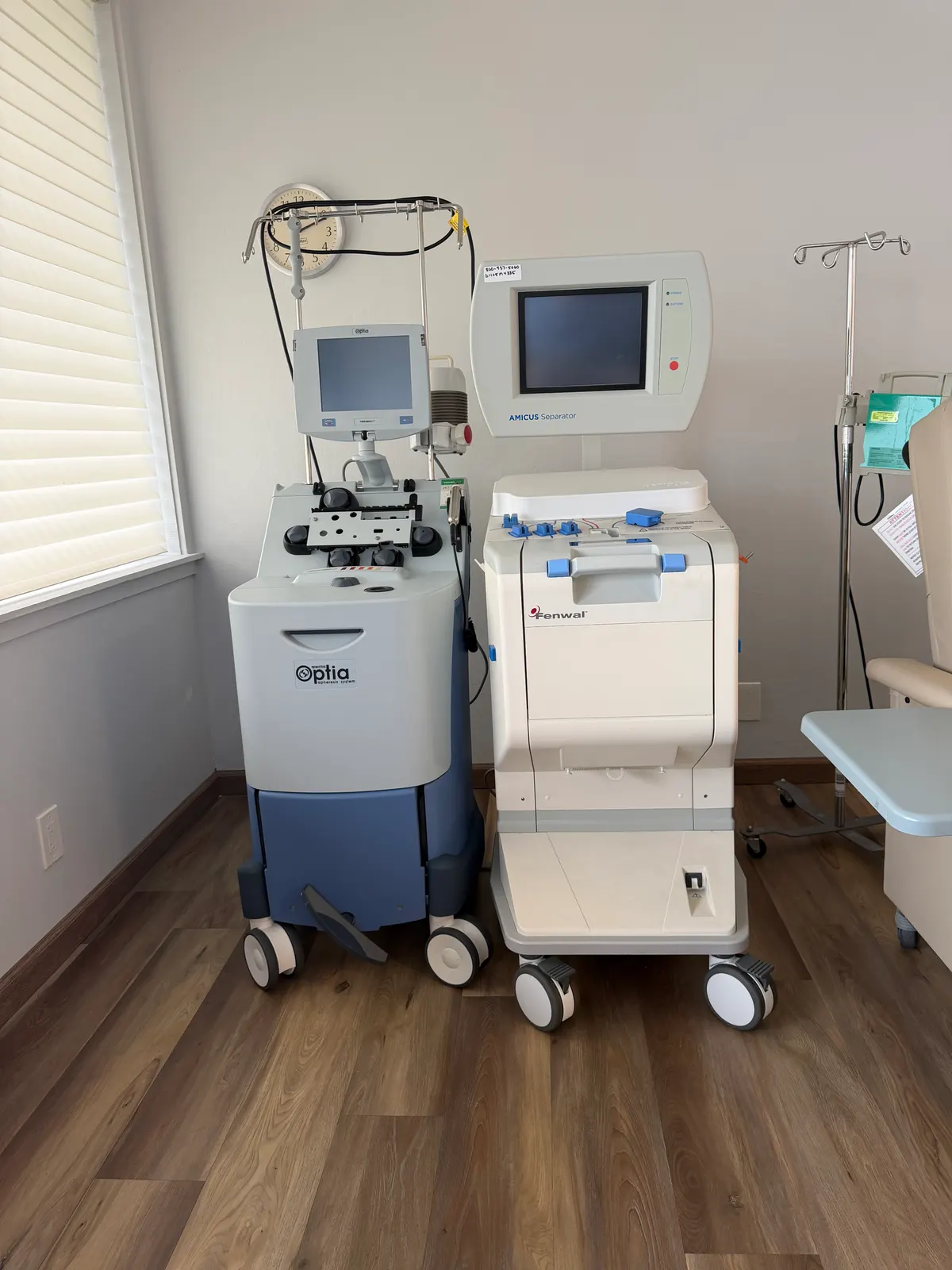
Therapeutic plasma exchange is a well-established medical procedure performed in thousands of hospitals worldwide. During TPE, an apheresis machine separates your blood into its components (red cells, white cells, platelets, and plasma) using centrifugal force. The plasma, which contains aged proteins, inflammatory mediators, autoantibodies, and accumulated waste products, is removed and discarded. It is then replaced with fresh 5% human albumin solution.
This is a total plasma exchange. The pathological molecules are physically removed from your body and replaced with clean, functional protein. TPE has been used clinically for decades, carries ASFA (American Society for Apheresis) guideline-categorized indications across dozens of conditions, and has an established safety profile across tens of thousands of procedures.
What EBOO Actually Does
EBOO uses a hollow-fiber dialysis membrane, typically an off-the-shelf hemodialyzer filter, through which your blood flows on one side while a mixture of ozone and oxygen gas flows on the other. The ozone diffuses across the membrane into the blood before the blood is returned to your body through a second IV line.
That is the core of the procedure. Despite the way it is marketed, there are several important distinctions patients should understand.
The Filter Doesn’t Filter
EBOO is frequently described as a “blood filtration” therapy. Some clinics call it “ozone dialysis.” But the hollow-fiber membrane in an EBOO circuit is not performing filtration in any meaningful sense.
In actual hemodialysis, these same filters work because there is dialysate solution on the other side of the membrane. Waste molecules in the blood cross the membrane into the dialysate along a concentration gradient, driven by controlled transmembrane pressure. That is how dialysis removes uremic toxins, through diffusion and convection into a receiving solution.
In EBOO, there is no dialysate. There is only ozone and oxygen gas on the other side of the membrane. Without a receiving solution to create a concentration gradient, and without the controlled ultrafiltration pressure that drives actual dialysis, the membrane cannot meaningfully remove solutes from your blood. Even some EBOO-friendly providers acknowledge this: one clinic’s own website describes the filter as acting “as a diffuser, exposing blood to a large surface area of ozone and oxygen,” not as a device that removes anything.
The membrane is being repurposed as a gas exchange surface. Calling it “filtration” is mechanistically inaccurate.
The “Toxins” in the Tubing Are Almost Certainly Fibrin
Many EBOO providers photograph a collection cup containing dark, clotted material from the circuit and present it to patients as visual evidence of “detoxification,” claiming it contains toxins, heavy metals, microplastics, or even parasites.
This material is far more likely fibrin and activated platelets, the predictable result of blood contacting foreign surfaces.
Contact activation of the coagulation cascade is one of the most well-characterized phenomena in hematology. When blood flows through any extracorporeal circuit, whether it’s a dialysis machine, a TPE circuit, or an EBOO device, proteins like fibrinogen adsorb to the foreign surfaces, Factor XII is activated, and fibrin is deposited. This is precisely why every extracorporeal blood circuit in clinical medicine requires anticoagulation with heparin or citrate.
Published research on hollow-fiber membrane devices specifically confirms that fibrin production, driven by contact activation of Factor XII, is the predominant mechanism of clot formation in devices with large surface areas and low shear rates, which describes an EBOO circuit exactly. The clotted material in the collection cup is not evidence that the treatment is removing toxins from your blood. It is evidence that your blood clotted when it touched plastic tubing and synthetic membranes, which is what blood does.
Even one of the more transparent EBOO providers acknowledges on their website that claims about the collection cup containing microplastics, heavy metals, or parasites are “unproven.”
How Your Blood Is Kept From Clotting
Beyond the question of filtration, patients should consider how their blood is anticoagulated during the procedure.
In our TPE practice, we use ACD-A (acid citrate dextrose), a citrate-based anticoagulant. Citrate provides regional anticoagulation, meaning it works only while the blood is inside the machine. Once the blood is returned to your body, citrate is rapidly metabolized by the liver. It does not thin your blood systemically, and its effects end when the procedure ends.
Most EBOO protocols rely on medium- to high-dose systemic heparin. The original EBOO clinical research by Di Paolo et al. described a 10,000 IU heparin bolus at the start of treatment. Unlike citrate, systemic heparin anticoagulates your entire body, increasing the risk of bruising or bleeding for hours after you leave the clinic. The greater concern, however, is cumulative exposure: repeated heparin administration carries the risk of heparin-induced thrombocytopenia (HIT), a rare but potentially life-threatening immune reaction in which the body paradoxically begins forming dangerous clots in response to the anticoagulant.
Performing medium- to high-dose systemic anticoagulation in a wellness clinic, away from the immediate capabilities of a hospital laboratory and hematology team, introduces a layer of risk that is rarely mentioned in social media marketing for EBOO.
The Oxidative Stress Paradox
This is perhaps the most important distinction between these two procedures, and one that is rarely discussed.
EBOO’s proposed mechanism of action is based on introducing ozone, a potent oxidizing agent, into the blood. The original research on EBOO by Di Paolo et al. confirmed that after a session, patients showed a 4-5 fold increase in thiobarbituric acid reactants (a direct marker of lipid peroxidation) and a corresponding decrease in plasma protein thiols. Proponents frame this as therapeutic “hormesis,” the idea that a controlled dose of oxidative stress stimulates the body to upregulate its own antioxidant defenses.
But consider what this means biochemically.
Albumin is the most abundant protein in human plasma, and it is the body’s primary circulating antioxidant. Research published in FEBS Letters has shown that more than 70% of the free radical-trapping activity of serum is attributable to human serum albumin. Albumin scavenges free radicals, binds pro-oxidant metals like copper and iron, and provides a critical free thiol group at its Cysteine-34 residue that acts as a sacrificial redox buffer protecting other molecules from oxidative damage.
When ozone is introduced into blood, it oxidizes those thiol groups. It consumes the very antioxidant capacity that albumin provides. The decrease in plasma protein thiols documented after EBOO is not a minor technical finding. It is direct evidence that the procedure is depleting your plasma’s primary antioxidant defense system.
Now consider what TPE does: it removes your old, oxidized, damaged plasma, including aged albumin whose antioxidant capacity has been degraded over time, and replaces it with fresh 5% albumin that has intact Cysteine-34 thiol groups and full free-radical scavenging ability. Research has demonstrated that reduced (fresh) albumin has significantly greater radical scavenging activity than oxidized albumin.
TPE restores your body’s primary antioxidant system. EBOO depletes it and relies on the hope that your body compensates through upregulation, a hormetic response that, while biologically plausible, has not been demonstrated to produce clinically meaningful outcomes in rigorous human trials.