
Post-Infectious

CIRS Treatment with Plasmapheresis

March 2026 · By Allen P. Green, M.D.

Woman experiencing chronic fatigue and pain, common symptoms of Chronic Inflammatory Response Syndrome (CIRS)

In August 2025, Jordan Peterson's daughter Mikhaila announced that her father had been diagnosed with Chronic Inflammatory Response Syndrome — CIRS — after years of debilitating symptoms that no one could fully explain. Profound fatigue. Cognitive decline. Food sensitivities so severe he could tolerate nothing but meat. Canceled tours, paused podcasts, and what Mikhaila described as pain-induced weepiness that the public had been watching for years without understanding its cause.

What made Peterson's case so striking wasn't just the severity. It was the timeline. His family now believes CIRS has been the underlying driver of his health problems since at least 2017. The formal diagnosis didn't come until 2025 — after a severe flare triggered by mold exposure while cleaning out his late father's home sent him into a spiral that ultimately landed him in the ICU with pneumonia and sepsis.

Peterson's experience put a name and a face on a condition that millions of people are living with — most of them undiagnosed.

At Global Apheresis, we've been treating patients with CIRS using plasmapheresis — also known as therapeutic plasma exchange — and seeing a pattern that traditional CIRS protocols alone often can't address. This article explains why, and what plasmapheresis offers that other approaches do not.

What Is CIRS?

Chronic Inflammatory Response Syndrome is a multi-system, multi-symptom illness first characterized by Dr. Ritchie Shoemaker. It occurs when the body's innate immune system becomes locked in an activated state, typically because it cannot clear certain environmental biotoxins.

The most common trigger is exposure to water-damaged buildings: mold, bacteria like actinomycetes, and volatile organic compounds. But CIRS can also follow Lyme disease, cyanobacteria exposure, and other biotoxin encounters. The trigger starts the process. The immune system's inability to shut it down is what makes it chronic.

The genetic component is significant. Roughly 25% of the population carries HLA-DR/DQ haplotypes that impair the adaptive immune system's ability to recognize and tag these biotoxins for removal. In these individuals, biotoxins don't get cleared. They recirculate through the blood and plasma, triggering inflammation that persists long after the original exposure has ended.

Why CIRS Is So Difficult to Diagnose

The symptom profile of CIRS reads like a medical catch-all. Patients present with clusters that span nearly every organ system: crushing fatigue unresponsive to rest, executive dysfunction and memory impairment that patients describe as “brain fog,” ice-pick headaches, joint pain and morning stiffness, shortness of breath, chronic sinus congestion, night sweats, excessive thirst, frequent urination, and sensitivity to light.

These symptoms overlap extensively with fibromyalgia, chronic fatigue syndrome (ME/CFS), and long COVID , which is not a coincidence. We'll return to that.

The diagnostic workup involves markers that most conventional physicians don't routinely order: Visual Contrast Sensitivity testing, MSH (melanocyte-stimulating hormone), VIP (vasoactive intestinal polypeptide), C4a, TGF-Beta 1, and ADH/osmolality panels. These markers paint a picture of immune dysregulation that standard bloodwork misses entirely.

This diagnostic gap is exactly what the Peterson family described. Years of symptoms. Multiple specialists. No unifying diagnosis until a clinician who understood CIRS finally connected the dots.

The Shoemaker Protocol, and Where It Falls Short

The standard treatment framework for CIRS follows the Shoemaker Protocol, a tiered approach that begins with removing the patient from the source of exposure and progresses through biotoxin binding with agents like cholestyramine, eradication of nasal biofilms (MARCoNS), and targeted hormonal correction.

This protocol helps many patients. For some, it resolves the condition entirely. But for a meaningful subset, particularly those with prolonged exposure, high toxin burden, or genetic profiles that make clearance especially difficult, oral binders and nasal protocols are not enough. The toxins continue to circulate. The inflammatory cascade continues. Symptoms persist.

This is where the conversation about plasmapheresis begins.

How Plasmapheresis Addresses What Oral Protocols Cannot

Plasmapheresis, also called therapeutic plasma exchange (TPE), works on a fundamentally different level than oral binders.

Cholestyramine and similar agents bind biotoxins in the small intestine, interrupting the enterohepatic recirculation loop. This is effective for toxins that cycle through the gut. But many of the inflammatory mediators driving CIRS (autoantibodies, cytokines, complement proteins like C4a, and the biotoxins themselves) circulate in the plasma. They are not accessible to oral binders.

Plasmapheresis removes the plasma directly. The patient's blood is drawn, separated into cellular components and plasma, and the plasma, carrying the accumulated inflammatory burden, is discarded and replaced with clean albumin solution. The blood cells are returned. The procedure takes two to three hours and is performed outpatient.

What this achieves is a reduction in circulating inflammatory mediators that oral protocols cannot reach. For CIRS patients who have done the foundational work but remain symptomatic, plasmapheresis addresses the residual burden that keeps the immune system locked in its activated state.
2–3 hrs

Per Treatment Session (Outpatient)

6

Initial Treatment Series (Typical for CIRS)

40+ yrs

Established Safety Record for TPE

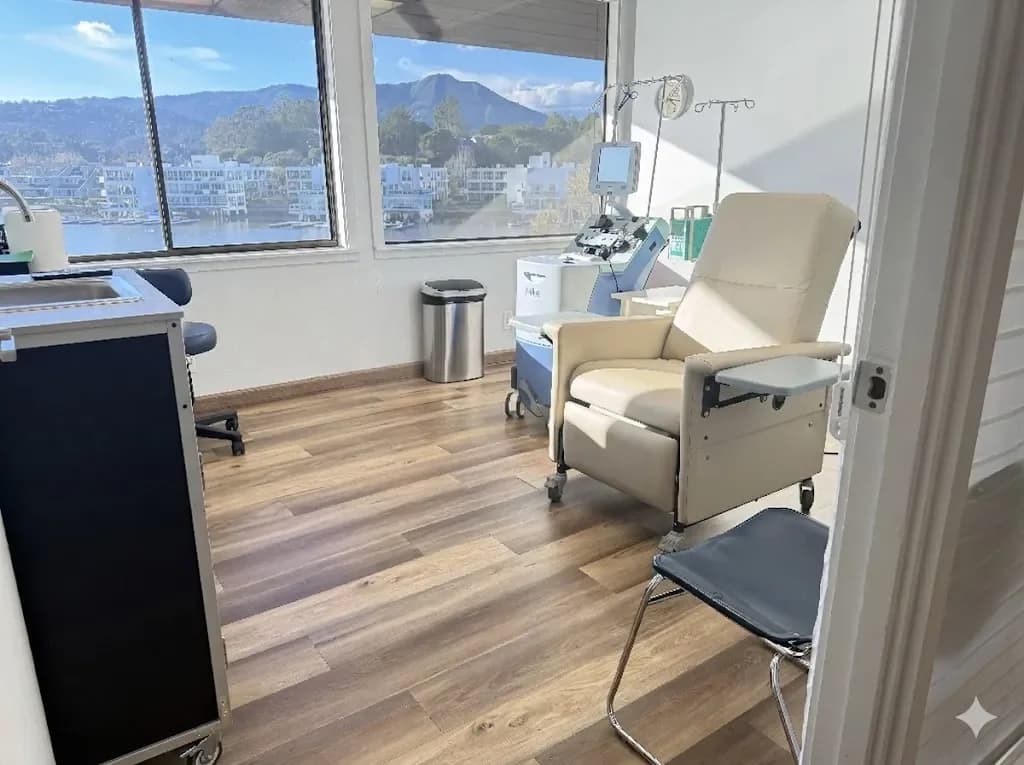
Therapeutic plasma exchange treatment room at Global Apheresis in Mill Valley, California

The Overlap with Long COVID, ME/CFS, and Other Post-Infectious Conditions

One of the most important insights in treating CIRS patients is recognizing that the underlying mechanism, a dysregulated immune system perpetuating inflammation through circulating pathogenic factors, is not unique to biotoxin illness.

Long COVID, PANDAS, chronic fatigue syndrome, and post-Lyme syndrome all share this fundamental pattern. The trigger differs: a virus, a bacterium, a biotoxin. But the result is the same. The infection or exposure resolves, but the immune system doesn't stand down. Autoantibodies, inflammatory cytokines, and other pathogenic factors continue circulating in the plasma, sustaining symptoms long after the original cause is gone.

Dr. Dobri Kiprov, the Medical Director of Global Apheresis and an internationally recognized authority in therapeutic apheresis, published the first case study on plasmapheresis for long COVID. His clinical data shows a 65% improvement rate across long COVID symptoms. He has treated patients with PANDAS who presented with OCD, tics, and severe psychiatric symptoms, and seen dramatic recoveries. A long COVID patient was wheeled into the clinic unable to walk and walked out after a single treatment.

The mechanism is the same across all of these conditions: remove the circulating pathogenic factors, and the immune system can reset. CIRS is the biotoxin variant of a pattern we see across the entire post-infectious and autoimmune spectrum.

What We're Seeing in CIRS Patients

We have recently treated a patient with confirmed CIRS who had been through conventional CIRS protocols with incomplete resolution. Following plasmapheresis, this patient reported improved energy levels after each treatment session, a response consistent with what we commonly observe across post-infectious and inflammatory conditions treated with TPE. Individual responses vary, and treatment plans are tailored accordingly.

We are also fielding a growing number of discovery calls from patients with CIRS, many of whom have found their way to us after exhausting traditional options. The Peterson diagnosis has undeniably driven awareness, but the underlying clinical demand was already building. Functional and integrative medicine practitioners, who make up a significant portion of our affiliate network , have been seeing CIRS patients for years and recognizing the limitations of oral protocols alone.

Our approach to CIRS follows the same framework we use for other chronic inflammatory and post-infectious conditions: an initial series of six treatments, followed by a maintenance phase tailored to the individual patient's tolerance and response. Some patients notice improvement after the first or second session. Others require the full initial series before the cumulative effect becomes clear. The cadence and duration of maintenance treatments vary, because the response is different for everyone.

This is not a replacement for the Shoemaker Protocol. Source removal remains the single most important step in CIRS treatment. Environmental remediation, binder therapy, and MARCoNS eradication all have their place. Plasmapheresis is what we offer when those steps have been taken and the circulating burden remains, when the body needs direct help clearing what it cannot clear on its own.

Can CIRS Be Cured?

This is the question every CIRS patient asks, and the honest answer is nuanced.

CIRS in its acute form, triggered by a specific exposure and treated with source removal and appropriate protocols, can resolve completely for many patients. The inflammatory cascade winds down, markers normalize, and symptoms clear.

For patients with the genetic susceptibility (the HLA-DR/DQ haplotypes present in roughly 25% of the population), CIRS becomes a lifelong vulnerability rather than a one-time event. These individuals will always be susceptible to biotoxin triggers. The goal shifts from cure to management: maintaining a clean environment, monitoring biomarkers, and intervening when flares occur.

Plasmapheresis fits into this management strategy as the most direct tool available for reducing circulating inflammatory burden when it accumulates, whether from a new exposure, an incomplete clearance, or the gradual buildup that some genetically susceptible patients experience over time.

The Bigger Picture: Why CIRS Awareness Matters Now

Mikhaila Peterson made a prediction in her August 2025 announcement: that CIRS would become a commonly diagnosed condition within five to ten years. Given what we see clinically, we believe she may be right.

The conditions that were once dismissed as psychosomatic or written off under catch-all diagnoses like fibromyalgia and chronic fatigue are increasingly being understood through the lens of immune dysregulation and circulating pathogenic factors. CIRS, long COVID, PANDAS, and post-Lyme syndrome are not identical conditions, but they share a common thread, and a common vulnerability to interventions that address the plasma directly.

At Global Apheresis, we sit at the intersection of clinical practice and this emerging understanding. Dr. Kiprov's forty-plus years of experience performing over 15,000 therapeutic plasma exchange procedures means that when new conditions like CIRS enter the conversation, we aren't starting from scratch. We are applying a well-established procedure, with a safety record spanning decades, to a newly recognized application.

For patients who are suffering with CIRS and have not found complete relief through traditional protocols, plasmapheresis deserves consideration. Not as a first step. Not as a replacement for environmental remediation. But as a powerful complement that removes what the body cannot remove on its own.

“For patients who have done the foundational work but remain symptomatic, plasmapheresis addresses the residual circulating burden that keeps the immune system locked in its activated state.”

References

  1. Shoemaker RC, House D, Ryan J. “Structural brain abnormalities in patients with inflammatory illness acquired following exposure to water-damaged buildings.” Neurotoxicology and Teratology. 2014.
  2. Kiprov DD, et al. “Therapeutic plasma exchange for long COVID: A case report.” F1000Research. 2021.
  3. McMahon SW, Shoemaker RC, Ryan JC. “Reduction in forebrain parenchymal and cortical grey matter swelling across treatment groups in patients with inflammatory illness acquired following exposure to water-damaged buildings.” Journal of Neuroscience & Clinical Research. 2016.

This content is for informational purposes only and does not constitute medical advice. Therapeutic plasma exchange for CIRS is based on clinical experience and the published literature on plasmapheresis for immune-mediated conditions. Consult a qualified physician to determine whether this treatment is appropriate for your situation.

Considering Plasmapheresis for CIRS?

Schedule a free discovery call with our physicians to learn whether plasmapheresis is right for your situation. We work collaboratively with your existing CIRS-treating physician.

Book a Free Discovery Call